

Overmountain Weavers Guild treasurer Louise Nuttle compares one of her textiles with a similarly patterned older coverlet from the Arrowcraft collection while teaching an Arrowmont weaving class. That coverlet was woven by Maggie Parton and represents one of the earliest textiles in the collection.
Introduction
Many influential figures in the Appalachian Craft Revival (1896-1937) lauded handwoven overshot coverlets as one of the finest expressions of the region’s handicraft traditions (e.g., Hall 1912). As a wave of university-educated women arrived from the North and more affluent communities in the South to establish settlement schools, folk schools, health centers, and other beneficial institutions, they encountered coverlets and saw an opportunity to encourage mountain women to revive this fading practice and generate much-needed income for their cash-poor communities (see Alvic 2009). In East Tennessee, a major weaving center developed at the Pi Beta Phi Settlement School (established in 1912), forming the core of its Arrowcraft commercial enterprise, which marketed handmade textiles to charitable alumnae of the national collegiate fraternity and tourists visiting the Great Smoky Mountains. The Settlement School’s successor institution after 1965, the Arrowmont School of Arts and Crafts, continues to teach weaving and other crafts on the same campus in Gatlinburg. It also holds a collection of Arrowcraft textiles and an archive of photographs and documents. Today, the school looks beyond the local community to draw studio artists and craftspeople from across the country. At the same time, weaving guilds and groups continue to research and teach new weavers in East Tennessee, and many of their members have deep roots in local traditional arts, often connected to the Settlement School, Arrowcraft, and Arrowmont.
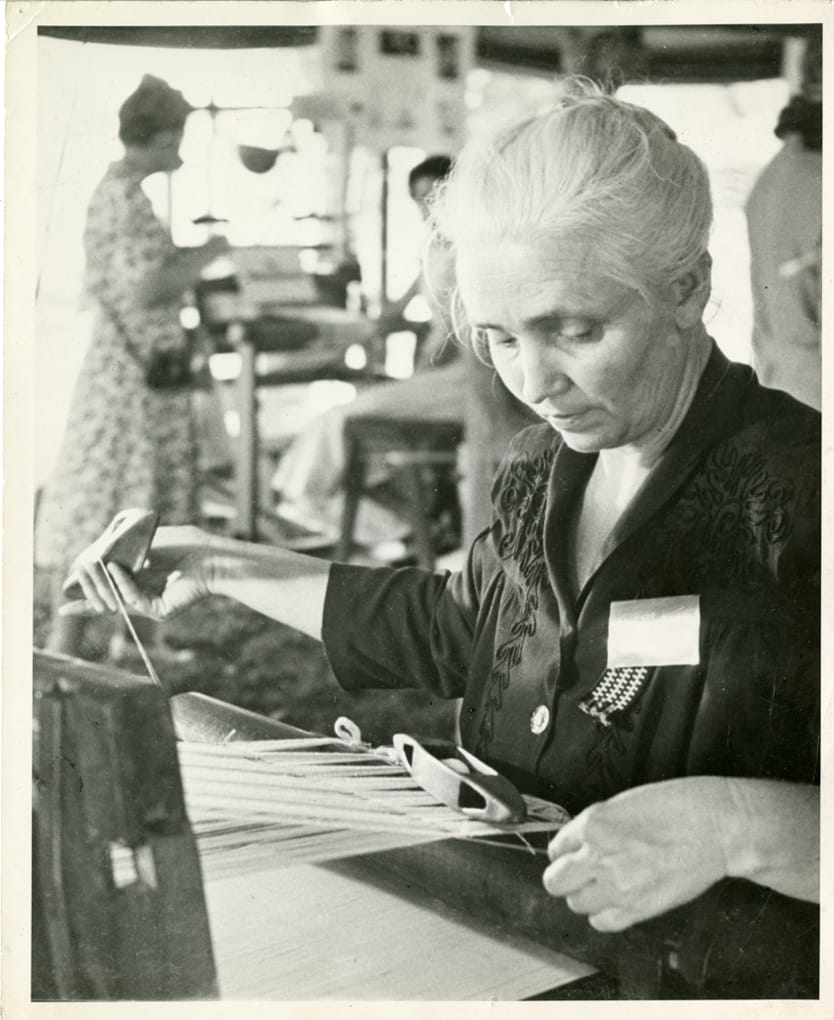
Cora Morton weaving, presumably at the Craftsman’s Fair of the Southern Highland Craft Guild, 1948. Unknown photographer. Arrowmont School of Arts and Crafts Archives at the University of Tennessee, Knoxville.
Finding Cora Morton
Looking down at her weaving in concentration, the white-haired woman in the photograph adjusts the thread at the selvedge of her work. Two wooden shuttles are at play. One holds a simple cotton or linen ground thread similar to the warp threads under tension on the loom; these threads interlace to form a stable foundation for the exuberant geometric designs created with the thicker pattern thread in the second shuttle. This is overshot weaving. The piece is narrow, perhaps a small home textile like a table runner or placemat, and the neatly dressed loom speaks to the expertise of the weaver. Most likely, the year is 1948, and the occasion is the first Craftsman’s Fair held by the Southern Highland Handicraft Guild on the grounds of the Pi Beta Phi Settlement School in Gatlinburg, Tennessee.
When I stumbled across this photograph at the University of Tennessee, Knoxville, in the archives of the Settlement School’s successor organization, the Arrowmont School of Arts and Crafts, I was immediately taken with the skill of the photographer and the beauty of the moment it documents–the grace of the weaver’s hands at work and the precision of her creation. I determined that it should go in the exhibition I was preparing at Arrowmont as a visiting scholar, but the identity of this woman was a mystery. I could tell that this was the Craftsman’s Fair, probably the first one, but there was no metadata, no writing on the back of the print.
The obvious next step and the common local advice for any historical mystery in Gatlinburg was to go talk to Frances. A small, effervescent woman in her mid-80s who still makes and sells brightly colored handwoven vests and jackets, Frances Fox Shambaugh has been involved with the school since she attended as a child in the 1940s. She is a local community scholar who gives weekly history presentations during workshop season at Arrowmont. As an accomplished fifth-generation Appalachian weaver, she is currently passing on her skills to her grandchild, Jess Cox, through a traditional arts apprenticeship funded by the Tennessee Folklife Program. During the 1980s, she was employed under Nella Cook Hill, the last weaving program supervisor and designer for Arrowcraft, the commercial handicraft enterprise operated by the Settlement School starting in 1926.1 If anyone could recognize the mystery weaver, she surely would.

Jess Cox (left) with Frances Fox Shambaugh (right) at the loom during their traditional arts apprenticeship with the Tennessee Folklife Program, 2024. Photograph by Evangeline Mee.
When I called on Frances at her nearby hillside home, we puzzled over the photograph while drinking steaming cups of red hibiscus tea. “I think I recognize the shape of her face. Could she be Jane–no, her mother? Yes, I think it’s her mother. Cora Morton. They were on an episode of The Heartland Series together, weaving and singing old gospel songs. It was so beautiful.” She was right, and, indeed, it is beautiful. The episode, called “Peace of Work,” shows Cora and Jane in the typical style of The Heartland Series, a television show that depicted traditional arts and culture in Appalachia through brief vignettes of people working, singing, making, cooking, and doing everything else that contributed to the rich tapestry of life in this region (Ellis 1984).
Now that I knew her name, I was able to find Cora Morton in the index of Philis Alvic’s book, Weavers of the Southern Highlands (2009, 179), where I learned that she wove for Arrowcraft for 47 years. Her daughter, Jane Nolan, also wove for Arrowcraft, and Jane’s daughters, Hope Reagan and Stella Lamon, weave for the shop at Ely’s Mill, a local historical site and tourist attraction. Morton was also documented by the photographer Edward DuPuy in Artisans of the Appalachians. He explains that her loom, so tidy in the 1948 photograph, was made by her brother and a friend,2 but by the 1960s, the treadles were wearing through, held together by cords and baling wire (1967, 82–3). Local woodworker Randy Whaley told me that Cora was his grandmother, and his Aunt Hope still has that loom, which was refurbished and is in working order. I recently bought a table runner woven by Hope in 2009 for the 75th anniversary of the Great Smoky Mountains National Park, and it uses the Whig Rose pattern that both Cora and Jane wove so prolifically.
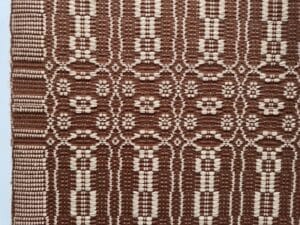
“Everything Whig Rose,” woven by Frances Fox Shambaugh in 1985 when she was studying weaving under Arrowcraft weaving department head, Nella Cook Hill. This wall hanging is a study of the Whig Rose overshot weaving pattern that shows how the weaver can improvise by changing the treadling sequence.
As a spinner and weaver, I am hungry for knowledge about the history of my crafts, but I rarely come across much personal information about the textile makers who came before me, particularly given that the majority were women and are often identified using their husbands’ names, when they are identified at all. In this case, though, from a single, unmarked photograph in the archives, a creative life story unfolded–not only of Cora, but also of her descendants and even of the loom on which she wove. To get there, I turned to informal, community-based knowledge, but that information was quickly enriched by careful documentation from people who admired these women and their work long before I ever heard their names or saw their faces. Finally understanding so much more about Cora Morton than I ever could have hoped to, I had her photograph enlarged and mounted, and I hung it in the Living Room area of the exhibition so that she could keep company with the work of weavers old and new and watch over those who tried their hand at weaving on the tiny looms available there.
My search for Cora Morton encapsulates the central issues at play in researching the history of community crafts in the context of Arrowmont. There are many resources available, including archives at the school, at the University of Tennessee, and in other locations, like the Folk Art Center of the Southern Highland Craft Guild in Asheville, North Carolina, and Berea College in Kentucky. Community members keep and teach their own histories as well, employing oral tradition, personal archives, and narrative objects that unlock memories of those who made and used them. Some of their stories have made it into books that document the folk traditions of the Great Smoky Mountains and the surrounding region. However, these resources inhabit separate worlds that may be more or less accessible depending on an individual’s technological skills, personal network, and sense of belonging in various institutional settings. The histories safeguarded therein have personal, educational, and artistic value to weavers in the region today, who have their own contributions to make in this ongoing story of traditional East Tennessee crafts.
As the 2024-25 Kenneth R. Trapp Craft Assistant/Curatorial Fellow at Arrowmont, I was tasked with curating a large exhibition using items from the permanent collection. During my research, I frequently came across points of connection and disconnection, which inspired me to work with community members to collaboratively design an exhibition and accompanying program that would help them reclaim the publicly available resources at Arrowmont and connect their own experiences with its collections and archives. At the same time, I recognized the limitations of this project. Shifting perceptions around access and belonging is not something that can be done with a single exhibition, especially given that there are material conditions behind those perceptions. Living in Gatlinburg, I became aware of a broad theme of displacement of local people and organizations for the sake of outsiders. Whereas local craft businesses once occupied prominent locations on the main strip in town close to the Arrowcraft shop, they have moved to the periphery, and their former locations are occupied by souvenir shops and tourist attractions.3 Arrowmont itself no longer has a presence on the strip and is mostly hidden behind storefronts and a tourist attraction that have grown up around it. Gates have become necessary to keep tourists from overwhelming the campus while seeking free parking. This adds to a sense of the campus no longer being as accessible as it once was.
Another issue is the difficult balance that Arrowmont must strike between its role in the local craft community and its prominence as an arts educational institution that draws contemporary artists and studio craftspeople from across the country. Alongside the more outward-facing orientation of its one- and two-week “national” workshops, Arrowmont offers shorter workshops more accessible to locals, discounts and scholarships, art classes for adults with disabilities, and classes and craft kits for schools. Despite the gates, the campus is open to the public, much of the archive has been digitized and is available online, and the library is free to use. Nevertheless, there is less local participation in the school than there once was when it had a much larger presence in community members’ lives because of its previous roles in local healthcare, childhood education, and cottage industries. Today, students, instructors, and staff members, who often come from outside the region, have varying degrees of awareness of the history of the school and how its relationship with the community has changed over time. In addition to inviting community members in, the exhibition was also intended to be an educational tool to help people connect with local handweaving practices and visualize the school’s shifting role in them over time.
The title of the Spring 2025 exhibition, Common Threads, refers to how the Arrowcraft weavers, alumnae of the Pi Beta Phi women’s fraternity, and early textile guild members transformed society by reaching across divides to uplift each other in solidarity. This was not simply a matter of charity. The women of Pi Beta Phi were formally educated at a time when women were denied most careers, and by establishing the settlement school, they created careers for themselves that allowed them to live independently and to make their own decisions. In Gatlinburg, they formed friendships, some married into local families, and they created community institutions not just for, but also in partnership with mountaineers. Mountain families supported their efforts and valued the education they provided, and they worked together to turn traditional crafts into a cottage industry that could support families and safeguard their culture at a time of rapid change. They succeeded: The children were educated, financial security increased, healthcare was far more accessible, and the women who ran the school lived independent lives while doing challenging and fulfilling work. Later, local people formed their own craft guilds and joined larger ones like the Southern Highland Craft Guild, while the settlement school shifted its focus to arts and crafts education. Craft, once a side interest of the settlement school and a way for locals to earn some cash in a barter economy, became a central concern.
Local weavers and the school share this history, but they also share a contemporary mission and commitment to craft. Alongside this institution of arts and crafts education, contemporary weavers are engaged in similar efforts to teach, learn, and hone their skills in community settings. This exhibition acknowledges many types of teaching and learning at work in the textile crafts of East Tennessee. It encourages viewers to do away with perceived divides between cottage industry and studio crafts, nationally known teaching artists and community educators. By showing how the women of Pi Beta Phi and local community members worked together to build an educational institution and make lasting change for themselves and their descendants, Common Threads suggests possibilities for mutual support and action in the present day, a vital lesson in a time of natural and manmade disasters that often seem insurmountable.
The Violin and the Fiddle: A Settlement School and Cottage Industry in Gatlinburg
When I began to study the history of the Pi Beta Phi Settlement School, I braced myself to encounter the patronizing sentiments and stereotypes about poor mountain folk common in early 20th-century mountain work (see Whisnant 2009), but despite occasional references to “simple” mountain people and the problematic nature of bringing Northern, middle-class values to the rural South, I was pleasantly surprised by the tone and content of most discourse coming from the fraternity in the early years of the school. Most often, the focus is on the need for education and healthcare as the result of poor roads and the lack of a cash economy. Rather than presenting generalizations about mountain people, we are introduced to individual Gatlinburg residents through photographs and accounts of their words and actions.
As Pi Beta Phi alumnae formulated their plan for a settlement school and began work, they published regular articles in their journal, The Arrow. While the articles reflect their time and the educated, middle-class, white demographic of the authors and audience, they also communicate a sense of solidarity with mountain families. For example, a 1911 issue of The Arrow features the transcript of a speech by Dr. Walter H. Page of the General Education Board,4 who claims that instead of providing formal education, it would be more efficient just to give children train tickets directly because education would only motivate them to move away from the mountains (Hubbard 1911). In April of the next year, a nuanced response appears from Edna L. Stone, which reads:
The old education, by which is meant knowledge acquired altogether from books, is too apt to make the young people dissatisfied with life in the mountains and to lead them away from home, leaving the life there impoverished rather than improved. What we wish to do is to join in the effort to show them how to use their own resources, to develop industries suitable to their environment, and to lead more happy, healthful lives. We want to help, as far as we can, to educate the mountain boys and girls back to their homes instead of away from them. (1912, 289)
That is, book learning was certainly important, but the school, from before its inception, was conceived to foster other, culturally relevant skills as well that would lead to healthier, more sustainable lives in situ, both improving people’s well-being and respecting their lifeways in their mountain communities.
We can see the seeds of Arrowcraft in 1910 when three members of the Pi Beta Phi Settlement House Committee5–Emma Harper Turner, May Lansfield Keller, and Anna F. T. Pettit–travelled into the mountains of East Tennessee to select a site for a settlement school (Pettit 1910). After illness delayed their trip to Gatlinburg, Keller was left to travel there with local assistance while the other women went to Asheville, where they visited Allanstand Cottage Industries, a major center of the Appalachian Craft Revival (1896-1937), and marveled at the weaving and basketry. Clearly, the visitors had already fallen under the spell of overshot weaving, given that they open their report with photographs of two coverlets, one featuring the Double Bow Knot draft (weaving pattern) and the other using the Seven Stars draft, along with images of the weaving process. Indeed, when expressing concerns about their ability to be accepted by and connect with the mountaineers, the 1912 Settlement School Committee report expresses that a shared love of beauty could be the key: “The mutual sympathy desired for our work may possibly find being and development through friendly intercourse between the violin and fiddle” (Gibson, Turner, and Matthews 1912, 622). Despite superficial differences, they held the arts in common, as well as appreciation for the natural environment, education and a healthy community.
Teaching began in 1912 in a temporary location, and that September, the fraternity and the community came together to purchase suitable land for a permanent campus. In March 1915, Mary O. Pollard, the Head Resident of the school, writes, “Many of the women make exquisite patchwork quilts, and some still make the hand woven coverlids and blankets. If a sale could be found for these articles, many might undertake the work” (1915, 393). The following year, we see the results in a report by Elizabeth Helmick on the formation of the manual training department, a “new and most valuable departure in our mountain school work” (1916, 440). Weaving and other handwork for pay was organized by Caroline McKnight Hughes starting in the autumn of 1915, under whose “talented supervision the school has been instrumental in reviving among the older women that almost forgotten art of spinning and weaving” (442). She established a system used for many years after: Weavers would bring their products to the school in exchange for cash in hand, and the school would market the products through its alumnae network.
Ten years later, the school hired Winogene Redding, a weaving teacher and designer originally from Nova Scotia, to formalize the weaving department, leading to the establishment of Arrowcraft as the cottage industry arm of the settlement school in 1926. From 1925 to 1945, and again in the early 1960s, Redding designed items, wrote patterns, trained weavers, visited mountain households, made friends, and advocated for the weavers and the program (Wise, Bridges, and Clement 2005). Among the many intelligent, motivated women who ran the Pi Beta Phi Settlement School, Redding’s voice is particularly powerful and personal, consistently emphasizing the individual stories of the weavers and the continuing need to support and organize them as major changes came to Gatlinburg.
In the 1920s, people began discussing the idea of establishing a national park in the Great Smoky Mountains, leading to an influx of visitors and surveyors. Redding found herself in a unique position at the center of a network of mountain women brought together by their work for Arrowcraft and participation in the Gatlinburg Weavers Guild, which officially formed in 1932 (Alvic 2009, 93). Their meetings were about more than weaving–they brought in outside speakers, hosted travelling exhibitions, and even produced a play written by one of their own, Lula Mae Ogle (1937). Redding was acutely aware of the changes coming to their town, and the weaving program became a hub for preparedness, helping local women learn the skills needed to navigate this new world while also providing a material support system and a means for solidarity. Redding (1933, 448) explains that the “Weavers Guild and the P. T. A. are the only organized groups in our village, which is growing by leaps and bounds. Civic improvement will be a big local issue in the next few years; fortunately, here are two groups of women beginning to realize they can do things. They are ready to undertake local problems beyond their weaving and school and have discovered that there is power in organization. Who knows where our weaving meetings will end?”

Community weaving class, 1929. Arrowmont School of Arts and Crafts Archives, University of Tennessee, Knoxville. Unknown photographer.
Finding Our Common Threads
I have met many descendants of the Arrowcraft weavers during my time in Gatlinburg. Although parts of the town have become a sort of carnival, with tourist businesses crowding the strip and vacation cabins popping up on every hill, their families continue to live in these mountains with all the comforts of contemporary life. Within the structural pressures and economic shifts that have constrained life for local people in the Smokies, the women of Pi Beta Phi and the Gatlinburg weavers did succeed in building something lasting for this community through the settlement school. We can see their impact in the stability of their families, who were able to stay in their homes rather than migrating to cities for work, and in the craft businesses that still bear their names. However, the weavers left another powerful legacy for their community–a body of work in the form of memoirs, interviews, photographs, and the textiles they wove.
When selecting items and designing the layout of the Common Threads exhibition, I focused on the early textiles in the Arrowcraft collection and took the visitor on a journey that mimics the initial encounters of visitors to mountain homes. One enters by stepping into an atrium draped with a dizzying array of large, elaborate coverlets, while in the center, three pedestals show the Whig Rose overshot pattern at a smaller scale on a matching set of placemats in many different colors. This display shows how the coverlet designs can be scaled and sampled to produce smaller, more accessible textiles. While coverlets were cited as the best example of fine textiles produced in these mountains (Eaton 1937, 56), they were large and time-consuming to make. This labor is represented in the second part of the exhibition, The Workshop, where unfinished samples, looms, and images of women weaving show visitors the tremendous effort that goes into making fabric.

Entrance of the Common Threads exhibition. Sandra J. Blain Galleries, Arrowmont School of Arts and Crafts, Gatlinburg, Tennessee. Photo by author, February 2025.
The third section of the exhibition, Home and Family, shows how Arrowcraft textiles were featured in domestic spaces and connected weavers across generations. Demonstrating how artistry manifests in small home textiles, it teaches viewers that, in the late 1920s through the early 1930s, the emphasis in textile production for Arrowcraft shifted from large items like coverlets to smaller items like towels and table runners. Redding explains that her designs had to “meet a different need in [the weavers’] homes as well as in the homes of others, and so it is necessary to give up the splendid but hard ways of their grandmothers and adopt new styles and methods that are in keeping with our modes of living in this generation” (1929, 5). Promoting these products largely through a network of charitable women, Arrowcraft’s sales were tailored to accommodate the financial constraints and lack of agency women experienced in their daily lives. Alvic explains that a “modestly priced set of placemats or a guest towel could be bought by dipping into household funds, where a more costly coverlet or rug required working within the larger family budget, often controlled by the husband” (2009, 164). Thus, by scaling down the coverlet patterns, Winogene Redding and the Arrowcraft weavers made it possible for alumnae across the nation to own a little piece of Appalachian folk culture while helping the weavers improve living conditions for their families, even within the gendered social and economic limitations of their time.
Solidarity was a major theme throughout this project. Frances Fox Shambaugh emphasizes that the women who ran the school acted out of friendship, not charity. Although some outsiders may have brought other motivations and attitudes to their work in these mountains, they did not stay long and left comparatively few written records. Speaking of figures like Winogene Redding and other longtime workers at the Settlement School, Frances explains, “These are the people that stayed and loved the people here, and the people loved them. And they came here to model, not to tell them what they ought to do.”6 The sense of shared purpose that developed through their friendships translated into a weaving program that was responsive to the needs of individuals and the larger community. During the Great Depression and World War II, weaving helped carry mountain families through tough times. Redding notes in her 1962 weaving report that as banks were closing during the 1930s, everyone in the weaving department took a 10 percent pay cut, but weaving continued. “There were periods when the weaving was spread thinly among the weavers, almost 100 of them before the war, in order for as many families as possible to have some cash income” (1962).

Two handwoven textiles are displayed on the same pedestal in the Common Threads exhibition, both using the same Monk’s Belt overshot pattern. The top one was woven by Frances Fox Shambaugh’s mother, Murrell Reagan, in 1937. The bottom one was woven by her great grandchild, Jess Cox, in 2025. Photo by author.
As I was reading her reports in the autumn of 2024, Hurricane Helene triggered devastating, deadly flooding in Western North Carolina and East Tennessee, and we saw a new wave of solidarity among mountain communities and from outsiders, who carried in supplies on foot, on horseback, and with mules to reach areas cut off by the storm. It was at this point that I decided that the historical portions of the exhibition should highlight the accomplishments of the weavers and the Pi Beta Phi workers who, wanting to help, chose a strategy not of charity but of community, living with the people they chose to serve, learning from them, being changed by them, and crossing barriers of geography and class to become friends. To reflect solidarity and collaboration in the Arrowcraft story and bring it into our time, I sought out local and regional weavers to see how they work together and support each other. I invited them to collaboratively curate the fourth and final portion of the exhibition, Weaving Community, which features works from contemporary weavers in and around the Great Smoky Mountains.
Over the Mountains and Through the Valley
East Tennessee is rich in craft guilds that safeguard handwork traditions by providing a framework for educational activities for their members and through public events. As I reached out to textile artists, I began to visit craft groups and guilds, including the Scenic Valley Weavers, the Tuesday Weavers at the Appalachian Arts Craft Center, the Foothills Guild, and the Southern Highlands Craft Guild. Ultimately, I joined two guilds: the Tennessee Valley Handspinners Guild in Knoxville and the Overmountain Weavers Guild in Kingsport. Spinning and weaving with these guilds brought me into fellowship with their members and helped open the door for collaboration on the Common Threads exhibition.
The archival and collections research I was conducting generated great interest in the guilds, and I learned that some members are doing related research. For example, the Overmountain Weavers have an antique weaving drafts project in which they are transcribing and recreating old weaving patterns. The guild is based at Exchange Place, a living history farm restored to the year 1850, and some of these drafts are the basis for textiles that guild members have woven to decorate the historic buildings onsite. Their founders’ histories are also represented in the archives, including figures like Persis Grayson, who taught at Arrowmont for many years and inspired the formation of both the Tennessee Valley Handspinners and the Overmountain Weavers (Tschantz 2012). Bringing their stories and photographs into the exhibition helped reinvigorate long-term connections between the guilds and Arrowmont that had formed through teaching and learning at the school since its reorientation to focus on arts and crafts education in the 1940s. By navigating the archives, collections, and library and presenting my findings, I was able to make guild members more aware of the resources available, leading to new opportunities for future collaboration.
To solidify these connections, provide an opportunity for the weavers to interact with each other, and help them to reclaim Arrowmont as a space for community gatherings and education, I planned a Fiber Arts Day with the guilds and a guest speaker, North Carolina coverlet expert Cassie Dickson, who lives just on the other side of the National Park. We held the event on campus in conjunction with the exhibition, but we worked with the Tennessee Valley Handspinners and the Wilderness Weavers, another local guild, to hold it on their regular meeting date. This way, guild members could follow their planned schedule with minimal interruption to their lives. Individual members drove over two hours from opposite directions to attend, so this event facilitated a rare opportunity for spinners and weavers who live on opposite sides of East Tennessee to meet and enjoy each other’s company. The event featured knowledgeable community members as the speakers in an informal environment that encouraged questions and conversation. One of Arrowmont’s volunteer librarians, Victoria Walker, who is also a member of the Tennessee Valley Handspinners, taught attendees how to access library resources and how to donate books to the library. Frances Fox Shambaugh gave a visual presentation on the history of weaving at Arrowmont, and Cassie Dickson gave a talk about her spinning and weaving practices, raising silkworms, and her history in the local weaving community. I introduced the school and its collections and gave a tour of the exhibition during which individuals who contributed items gave impromptu talks. Much like the exhibition itself, this event became a vehicle for community building and collaboration, as spinners and weavers learned from each other and presented their work in an environment of mutual respect and support.

Historic building at Exchange Place Living History Farm in Kingsport, Tennessee, where the Overmountain Weavers meet, hold weaving classes, and keep their library. Photo by author, 2024.
Conclusions
The stories of Arrowcraft and the textile guilds of East Tennessee not only show how weavers’ lives and work are interwoven, but they also exemplify how communities can form around traditional crafts and expand their purview to make lasting changes in difficult times. They remind us of the power of solidarity and mutual aid, as well as the ability of women to organize under hostile conditions to uplift each other and their families.
Arrowmont’s history is central to the history of East Tennessee’s craft communities, and they can also play a powerful role in its future. Many artisans and community members worked to build and maintain the school, so Arrowmont’s history is also their history. Balancing community needs, local perceptions, financial considerations, and governance are ongoing challenges for any organization, but efforts like this exhibition and fiber arts event can help reinvigorate old relationships and foster new ones. One attendee told me that they had never had anything like this before, an exhibition that really spoke to the skill and artistry of local weavers with respect for their work and lives. Another asked if her guild could transcribe and weave some of the antique weaving drafts in our collection, an offer that represents an opportunity for ongoing partnership between Arrowmont and these community educators and researchers. Still others spoke of wanting to take or teach workshops at Arrowmont, and seeds were planted for holding retreats and other organized events at the school.
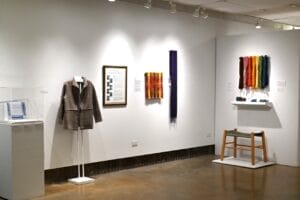
Display of items from the Overmountain Weavers in the Common Threads exhibition, including antique drafts, project textiles, and educational display of naturally dyed yarns. Photo by author, 2025.
One of the greatest benefits of this exhibition is how the research process mapped the many locations where source materials are held, the main books and articles about the craft revival in East Tennessee, and many untold parts of Arrowmont’s history. Frances Fox Shambaugh lost her archives in 2016 when one of the Great Smoky Mountains wildfires raged through Gatlinburg, but this project has helped restore some of those records. In addition, four envelopes of photographs taken and annotated by Winogene Redding were digitized by the Batey family, local artists who have a long relationship with the school and the arts community of Sevier County.
Along with Cora Morton’s story, we have found so many others in scattered notes on the backs of old photographs, letters, mentions in publications, and the memories of Gatlinburg residents. We found photos from the 1920s of brave Rex the collie, the dog of woodworker O.J. Mattil, who led nurse Phyllis Higgenbotham on safe paths during her urgent night visits by the sight of his fluffy white tail in the darkness. We laughed with Winogene Redding about how Allen Eaton, famed author of Handicrafts of the Southern Highlands (1937), was arrested for climbing over the barrier at the first Craftsman’s Fair in Gatlinburg at the spry age of 67, which put into perspective a shaky film of the event that lingers on him standing by the fence. Each detail helps to build a stronger understanding and more human picture of the craftspeople who came before and the lives they lived in the Great Smoky Mountains. Frances’s weekly history presentations on campus during national workshops, now enriched by new images and anecdotes, will continue to help Arrowmont’s students remember the people who came together over a century ago in the name of education and traditional crafts to live in fellowship with the mountain families of Gatlinburg.
The Pi Beta Phi Settlement School had a real impact on people’s lives that we can still see at Arrowmont and in the many craft businesses in Gatlinburg and textile guilds in East Tennessee. Many women who came from other places to work at the school lived independent lives doing work that challenged them and helped others, thus defying gender norms to seek fulfillment outside of marriage and domestic life. The community, meanwhile, saw improvements in education and health and benefitted from a social hub that empowered them to organize and better their own lives. The craft knowledge of earlier times is still strong today thanks to the cottage industry that the school encouraged, which then developed into dozens of independent enterprises. For mountain people, these craft businesses allowed them to support their families while living their lives as they saw fit, staying close to the homeplaces that they loved and working with the rhythms of family needs and agricultural life. Cora Morton (Ellis 1984) sums up this mix of material improvement, fulfilling labor, and social support in her 47 years of weaving for Arrowcraft: “For one thing, I was helping make some money to support the family. That was one thing about it. It got my mind away from the other things of life. You have to put your mind to your weaving when you’re weaving. We used to have what we called weaving meetings once a month where we had refreshments, sung the Old Harp. We enjoyed it.”
Mathilde Frances Lind is a folklorist and fiber artist with a PhD from Indiana University Bloomington. Her research focuses on traditional textile crafts and folk ecologies, most recently in the Great Smoky Mountains as the Kenneth R. Trapp Craft Assistant/Curatorial Fellow at the Arrowmont School of Arts and Crafts. Starting in September, she will join the Artisan Development Program at North House Folk School in Minnesota to spend two years honing her skills in Northern European weaving and textile tool restoration.
Acknowledgements: Many thanks are due to the community members and guilds who invited me in and taught me so much. This project was enriched by the generosity of two archivists: Pi Beta Phi Archivist and Historian, Fran Desimone Becque, and Southern Highland Craft Guild Archivist, Michael Hatch. Kaila Clark at the Anna Porter Library provided key assistance, not just with helping me navigate the library’s Smoky Mountain Collection, but also by organizing, attending, and documenting events with local weavers. Thanks also to Arrowmont CEO Trudy Hughes for embracing radical generosity with the school’s archives and records and for her unflagging support of my work to help tell the stories of the strong women who built it.
Endnotes
- Interview with Frances Fox Shambaugh by Mathilde Frances Lind, January 23, 2025, Gatlinburg, Tennessee.
- 2. The friend may have been Frances’ grandfather, Harve Reagan. Personal communication, May 15, 2025.
- Although much of the tourist infrastructure predates it, portions of Gatlinburg’s built environment have changed very quickly over the last decade after the 2016 fire destroyed parts of the town. For more on community responses in the rebuilding process, see Varajon 2021.
- 4. The General Education Board was a private organization established by John D. Rockefeller, Sr. From 1903 to 1964, it supported state school systems, colleges, and universities, particularly in the South. See Tevis 2014.
- 5. The committee only later changed its language to “Settlement School.” This reflects the urban roots of the settlement movement in the United States, where settlement houses were established in city neighborhoods with large immigrant populations as a “buffer against social and economic exploitation and a tool for self-directed social betterment” (Whisnant 2009, 44). According to records in The Arrow, Pi Beta Phi alumnae were already active in settlement work before coming to Gatlinburg, so they are likely to have been aware of the “settlement house” terminology.
- 6. Interview with Frances Fox Shambaugh by Mathilde Frances Lind, April 22, 2025, Gatlinburg, Tennessee.
Works Cited
Alvic, Philis. 2009. Weavers of the Southern Highlands. Lexington: University Press of Kentucky.
DuPuy, Edward L. and Emma Lincoln Weaver. 1967. Artisans of the Appalachians. Asheville: The Miller Printing Co.
Eaton, Allen H. 1937. Handicrafts of the Southern Highlands: With an Account of the Rural Handicraft Movement in the United States and Suggestions for the Wider Use of Handicrafts in Adult Education and in Recreation. New York: Russell Sage Foundation.
Ellis, Edye (anchor). 1984. The Heartland Series, Season 1, episode 21. Peace of Work. WBIR Channel 10, 3:17 min., stream at https://www.wbir.com/video/entertainment/television/programs/heartland/heartland-series-vol-1-episode-21-peace-of-work/51-a6829358-1a51-43e6-a528-175dd3ca1603.
Gibson, Mary Wallahan, Emma H. Turner, and M. Alice Matthews. 1912. Report of Committee on Settlement School. The Arrow: Official Publication of the Pi Beta Phi Fraternity. Convention Number 5:621–8.
Helmick, Elizabeth A. 1916. News from Little Pigeon: Improvements and Accomplishments This Year as Seen by Our Chairman and Treasurer. The Arrow: Official Publication of the Pi Beta Phi Fraternity. 32.3:439–41.
Hubbard, Florence E. 1911. Work Among the Southern Mountaineers. The Arrow: Official Publication of the Pi Beta Phi Fraternity. 27.4:427–34.
Ogle, Lula Mae. 1937. Store Britches–A Story of Way Back Yanner: An Original Three Act Comedy of Mountain Folk-Lore. Anna Porter Library Smoky Mountain Collection. Theater script and program.
Pettit, Anna F. T. 1910. A Trip of Investigation Made by the Settlement House Committee. The Arrow: Official Publication of the Pi Beta Phi Fraternity. 27.1:49–53.
Pollard, Mary O. 1915. Good News from Little Pigeon. The Arrow: Official Publication of the Pi Beta Phi Fraternity. 31.3:392–94.
Redding, Winogene B. 1929. An Old Art Modernized. Handcrafter. 1.6:3-5.
———. 1933. Weaving Meeting Day in Gatlinburg. The Arrow: Official Publication of the Pi Beta Phi Fraternity. 49.4:448–49.
———. 1962. Report of the Weaving Department–Arrowcraft Shop–May 1962.
Stone, Edna L. 1912. The Pi Beta Phi Settlement School. The Arrow: Official Publication of the Pi Beta Phi Fraternity. 28.3:288–92.
Tevis, M. M. 2014. Philanthropy at Its Best: The General Education Board’s Contributions to Education, 1902–1964. Journal of Philosophy and History of Education. 64.1:63-72.
Tschantz, Penny. 2012. Guild History. Tennessee Valley Handspinners Guild, https://tnvalleyhandspinners.org/about-tvh/history.
Varajon, Sydney. 2021. Building Relationships: Community, Rebuilding, and Architectural Succession After the 2016 Gatlinburg Fire. Doctoral dissertation, The Ohio State University, http://rave.ohiolink.edu/etdc/view?acc_num=osu163843232749491.
Whisnant, David E. 2009. All That Is Native and Fine: The Politics of Culture in an American Region. Chapel Hill: The University of North Carolina Press.
Wise, Ken, Anne Bridges, and Russ Clement, eds. 2005. The ‘Chief Indoor Sport of Gatlinburg’: Winogene Redding and the Pi Beta Phi Settlement School’s Weaving Program. Great Smoky Mountains Colloquy. 6.2:1–3.
Urls
Arrowmont School of Arts and Crafts https://arrowmont.org
Tennessee Folklife Apprenticeship https://tnfolklife.org/programs/traditional-arts-apprenticeship-program/apprenticeship-teams/2025-2/shambaugh-and-cox-overshot-weaving
The Heartland Series https://www.wbir.com/video/entertainment/television/programs/heartland/heartland-series-vol-1-episode-21-peace-of-work/51-a6829358-1a51-43e6-a528-175dd3ca1603
Allanstand Cottage Industries https://www.wcu.edu/library/DigitalCollections/CraftRevival/story/allanstand.htm